
Radio Frequency (RF) Reading

ESL has over 30 years’ experience providing safe, accurate, and reliable reading service technology for water utilities and privately owned water systems.

Contact Us

Efficient Meter Reading Solutions

With over 30 years of experience, Evan Supply offers advanced meter reading technologies to streamline your data collection process. Whether through remote or on-site solutions, we prioritize accuracy and efficiency.

Icon of a circuit board with a wrench, symbolizing circuit repair or electronic maintenance.

Advanced RF Technologies

Benefit from highly reliable and accurate meter readings using advanced radio frequency systems designed to perform in even the most challenging environments.

Two overlapping blue outlined circles with a dashed line at the intersection.

Seamless Integration

Easily incorporate our solutions into your current infrastructure, ensuring minimal disruption while maximizing efficiency and compatibility with existing systems.

Blue outline icon of an open hand with three fingers raised.

Reduced Operational Costs

Lower your overall expenses by optimizing labor, minimizing manual intervention, and reducing errors in data collection and management.

The Future of
RF Meter Reading

Evan Supply is at the forefront of Radio Frequency (RF) meter reading, combining innovative technology with unparalleled expertise. Our RF solutions are designed to make data collection faster, more accurate, and cost-effective.

Streamlined RF Reading Solutions for Your Needs

For meter populations that are entirely RF, we offer both mobile and fixed base reading services. This allows you to eliminate the need for costly investments in reading equipment.

Blue clock with an arrow circling clockwise symbolizing delivery time or fast service.

Real-Time Data Access

Gain instant access to critical meter readings, empowering you to make faster and more informed decisions without delays or inaccuracies.

Blue target with concentric circles and crosshairs symbolizing accuracy.

Enhanced Accuracy

Minimize the risk of human errors with automated data collection systems that ensure precision and reliability in every reading.

Blue gear and clock icon representing efficiency and time management.

Cost Efficiency

Streamline operations and significantly reduce labor costs by utilizing advanced RF systems that optimize your workflow and resources.
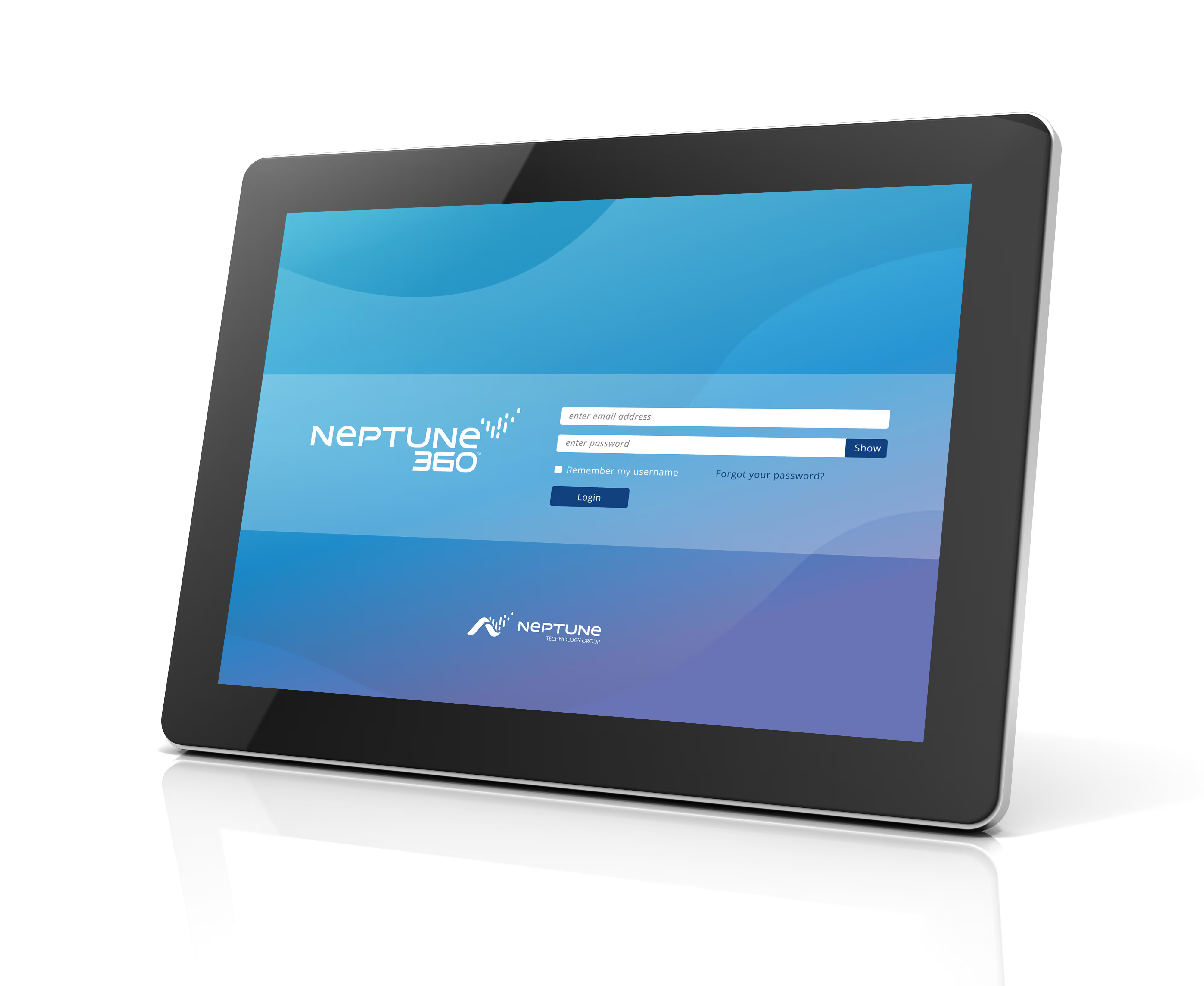
Tablet displaying Neptune 360 login screen with fields for email, password, and login options.
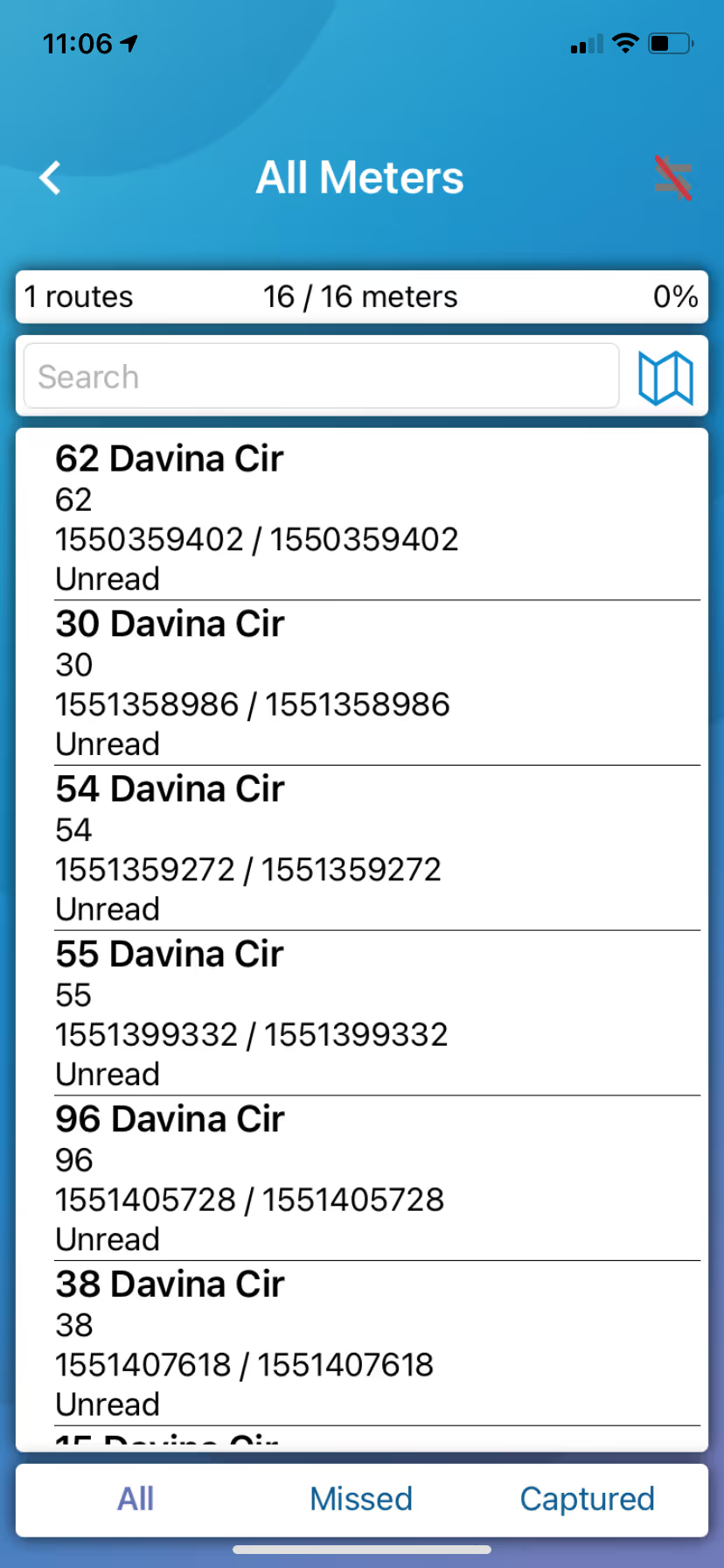
Smartphone screen displaying water consumption bar chart for Oct 15 to Nov 15, 2022, with gallons per meter and missed readings data.

Customizable RF Solutions

We provide flexible RF reading systems to meet your unique needs. Whether it’s fixed networks, drive-by systems, or hybrid models, our solutions ensure reliability and adaptability for any application.

Fixed Network Systems

Experience the convenience of continuous data monitoring and collection, ideal for large-scale applications and fixed infrastructure.

Drive-By Systems

Optimize efficiency with our mobile RF solutions, allowing reliable and quick data collection over expansive areas with minimal effort.

Hybrid Models

Combine the best of fixed and mobile systems to create a versatile and scalable RF solution that adapts to changing operational requirements.

RF Reading

We Are Ready to Help

ESL can provide mobile or fixed base reading services so that you don’t have to invest capital in the reading equipment.

Help Center

Frequently asked questions

Answers to what municipalities ask most about Evan Supply waterworks training.

How accurate are municipal water meters?

New positive-displacement water meters from 5/8" to 2" leave the factory registering within ±1.5% under AWWA standards. Accuracy declines with age and throughput; worn measuring elements register less water than actually flows. The direction of error matters: mechanical meters slow down as they wear, so an old meter under-bills rather than over-bills.

What is non-revenue water?

Non-revenue water is treated water that earns the utility nothing: lost to distribution leaks, meter under-registration, unauthorized use, or billing gaps. Water billing is typically a municipality's second-largest revenue source after taxes, so every percentage point of under-registration compounds directly against the water budget. A meter accuracy program and reliable read data are the two levers a utility controls most directly.

What happens if a gateway goes offline?

Endpoints keep transmitting, and many reach an alternate gateway if one is in range, but endpoints that relied on the offline gateway stop delivering reads. If nobody notices, those accounts drift onto estimated billing until the gap surfaces weeks later. Daily gateway-health review catches the drop the same day so it can be worked before it becomes a billing problem.

Can a water meter over-register and over-charge?

Positive-displacement meters, the type in most Ontario homes and light commercial settings, cannot over-register by design. As internal components wear, they record less water than passes through, not more. A sudden high bill on an aging meter is almost always consumption or a leak, not the meter running fast. Meter accuracy testing settles the question.

How does better metering increase utility revenue?

By billing for water already being delivered. Aging meters under-register, dead endpoints push accounts onto estimates, and wrong-sized commercial meters miss low-flow consumption. All of it is water treated and pumped but never invoiced. Recovering it needs no rate increase: accurate meters, working endpoints, and read data someone actually reviews.

Why does it matter if meter reads stop arriving?

Because billing quietly falls back to estimates, and estimates eventually get corrected all at once. In Toronto, a failed meter transmitter left one property on estimated billing for nearly three years; when a manual read confirmed actual usage, the owner received a single catch-up bill covering the difference (reported by CTV News / Money.ca, May 2026). Catching a dead endpoint or gateway in days instead of years is the difference between a service ticket and a five-figure surprise.

How often should water meters be tested?

AWWA's M6 manual recommends testing on a schedule tied to meter size: 5/8"–1" meters roughly every 10 years, 1"–4" meters every 5 years, and meters 4" and larger annually. Large meters get the short cycle because a 2% error on a high-volume account costs more revenue than the same error on a house. Statistical sampling across the meter population takes the guesswork out of replacement timing.

Why are utilities replacing meters that still work?

Because a meter that turns is not the same as a meter that's accurate. Mechanical meters lose accuracy years before they stop, and past 15–20 years the unbilled share grows quietly. Replacement programs timed to age and sample-test data, usually paired with an AMI endpoint upgrade, recover revenue and cut manual reading costs in the same project.

Who regulates water meter accuracy in Canada?

Measurement Canada regulates gas and electricity meters but has left water meters status quo, so Canadian water utilities self-regulate meter sizing, selection, testing, and replacement against AWWA standards, as they have for over a century. That makes a documented testing program the utility's own evidence of billing accuracy.

What does water meter data logging tell a utility?

A data log shows time-stamped consumption for one account: when the water moved, hour by hour, rather than a period total. It answers disputes ("the bill says 40 m³, but when?"), confirms or rules out leaks, reveals night-time continuous use, and shows whether a commercial meter is sized to its actual flow profile. For billing disputes it replaces argument with a record.

How long does a water meter last?

Water meters have a useful life of roughly 15–20 years. As they age past that range, under-registration grows and the utility gives water away unbilled. Utilities typically time replacement programs against age, throughput, and sample-test results rather than waiting for outright failure. Meter replacement projects are also the natural moment to move to AMI endpoints.

Why did my water bill go up after a new meter was installed?

Because the old meter was under-registering. Aging mechanical meters slow down and miss a share of actual consumption; a new meter records what actually flows. If usage habits haven't changed, a higher bill after replacement usually means the old meter had been giving water away. The new reading is the accurate one. Newport Beach and Wichita Falls document the same pattern in their public meter-replacement FAQs.

Still have questions?

Our field specialists are ready to help you plan a session.

Talk to a specialist →

Want more information?

Send us a message and we will get back to you as soon as possible.

THANK YOU
Your submission has been received!
Oops! Something went wrong while submitting the form.
Contact Us
PROUD SUPPORTERS OF
Water for People